Macroinvertebrates:
Aquatic macroinvertebrates are a group of animals that are large enough to see ("macro") and that do not have an internal skeleton, or backbone ("invertebrate"). You see these animals in lakes all the time, even though you may not pay them much attention. Common aquatic macroinvertebrates include water beetles, dragonfly nymphs, mussels, snails, hellgrammites, leeches, and worms.
Macroinvertebrates play an important role in the food web because they provide food to higher trophic levels. They are a key link between the producers and the secondary or tertiary consumers in the ecosystem’s food web. If you enjoy fishing, you already know this...many lures are designed to mimic macroinvertebrates in the water or on the surface.
Other macroinvertebrates, like freshwater mussels, filter particles from the water, helping to increase water clarity.
Macroinvertebrates are also commonly used as water-quality indicators because they are sensitive to pollution and changes in their habitats, large enough to be seen with the eye, have a long life cycle, and are common in rivers and streams.
Aquatic macroinvertebrates are a group of animals that are large enough to see ("macro") and that do not have an internal skeleton, or backbone ("invertebrate"). You see these animals in lakes all the time, even though you may not pay them much attention. Common aquatic macroinvertebrates include water beetles, dragonfly nymphs, mussels, snails, hellgrammites, leeches, and worms.
Macroinvertebrates play an important role in the food web because they provide food to higher trophic levels. They are a key link between the producers and the secondary or tertiary consumers in the ecosystem’s food web. If you enjoy fishing, you already know this...many lures are designed to mimic macroinvertebrates in the water or on the surface.
Other macroinvertebrates, like freshwater mussels, filter particles from the water, helping to increase water clarity.
Macroinvertebrates are also commonly used as water-quality indicators because they are sensitive to pollution and changes in their habitats, large enough to be seen with the eye, have a long life cycle, and are common in rivers and streams.
Macroinvertebrates in Lake Lacawac
There are many types of macroinvertebrates in Lake Lacawac and other Pocono lakes. These are a few important groups:
|
INSECTS
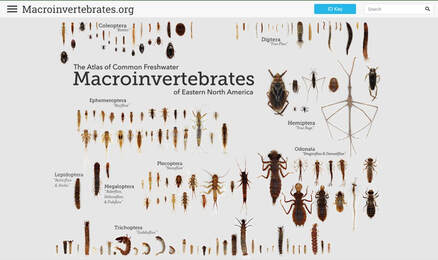
Many kinds of insects complete all or a part of their life cycle in the water. Dragonflies, mosquitos, mayflies, stoneflies, beetles, and dobsonflies are just some examples. Use the Learning to See, Seeing to Learn Project's Atlas of Common Freshwater Macroinvertebrates to explore the diversity of insects in your lake. |
MUSSELS
Freshwater mussels are a vital part of many lake ecosystems. They are filter-feeders, which means they remove particles from the water, often at incredible rates. One mussel can filter up to 10 gallons of water per day! However, many native mussel species are endangered. Roger Thomas of the Academy of Natural Sciences at Drexel University has surveyed Lake Lacawac for mussels. Watch the videos below to learn more.
Freshwater mussels are a vital part of many lake ecosystems. They are filter-feeders, which means they remove particles from the water, often at incredible rates. One mussel can filter up to 10 gallons of water per day! However, many native mussel species are endangered. Roger Thomas of the Academy of Natural Sciences at Drexel University has surveyed Lake Lacawac for mussels. Watch the videos below to learn more.
|
Learn more about freshwater mussels...where they are, their life cycles, and what challenges they are facing.
|
Learn what kinds of freshwater mussels are in Lake Lacawac and how they contribute to this ecosystem.
|
JELLYFISH
Yes...there are freshwater jellyfish...more appropriately called "jellies" as they are not fish at all but cnidarians. Like marine jellies, freshwater jellies uses their tentacles to sting and capture their prey, in this case zooplankton.
There are freshwater jellies (Craspedacusta sowerbii ) in Lake Lacawac. These jellies are not native to North America, but have been introduced to many waterways in the Northeast. They are small, usually less than one inch in diameter. Sharp observers can sometime see them swimming in Lake Lacawac, particularly when the "bloom", or reach large abundances.
Yes...there are freshwater jellyfish...more appropriately called "jellies" as they are not fish at all but cnidarians. Like marine jellies, freshwater jellies uses their tentacles to sting and capture their prey, in this case zooplankton.
There are freshwater jellies (Craspedacusta sowerbii ) in Lake Lacawac. These jellies are not native to North America, but have been introduced to many waterways in the Northeast. They are small, usually less than one inch in diameter. Sharp observers can sometime see them swimming in Lake Lacawac, particularly when the "bloom", or reach large abundances.
Sources
Macroinvertebrate Resources
Stroud Water Research Center. stroudcenter.org/macros/
https://www.sciencedirect.com/science/article/pii/S0065250417300260
Stroud Water Research Center. stroudcenter.org/macros/
https://www.sciencedirect.com/science/article/pii/S0065250417300260